
Large-Format Printing: Uses, Materials, Costs & Business Benefits Guide
Introduction
Large-format printing is one of the most effective visual marketing tools for businesses. From storefront signage and real estate boards to event graphics and construction plans, it enables companies to create high-impact visuals that are visible from a distance and built for durability. Understanding large-format printing helps you select the right materials, printing technology, and service provider to maximize your brand’s visibility.
What Is Large-Format Printing?
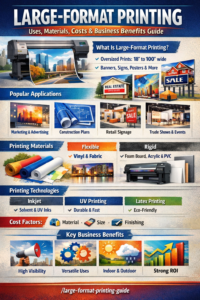
Large-format printing refers to printing oversized materials, typically 18–100 inches wide. Specialized printers handle large media rolls or rigid substrates to produce banners, posters, murals, and architectural graphics. While “large format” describes the overall category of oversized prints, “wide format” usually refers to printers handling media widths of 18–100 inches.
Why Businesses Use Large-Format Printing
Businesses choose large-format printing because it delivers high-visibility marketing that captures attention and communicates messages effectively. These prints provide durable indoor and outdoor signage, are compatible with a wide range of materials, and can be cost-effective for short-run custom graphics.
Common Applications
Large-format printing is used extensively across marketing, business, retail, construction, architecture, events, and entertainment. Marketing and advertising applications include banners, window graphics, wall murals, and trade show displays. Retail and business uses cover store signage, promotional displays, and point-of-sale graphics. In construction and architecture, large-format prints are used for blueprints, site signage, and safety notices. Events and entertainment rely on stage backdrops, event banners, and exhibition graphics.
Materials for Large-Format Printing
The choice of material significantly affects durability, cost, and visual quality. Flexible materials include vinyl, fabric, and mesh banners suitable for outdoor conditions. Rigid materials like foam board, acrylic, PVC, and wood or composite panels are ideal for long-lasting displays. Flatbed printers can also print on glass, wood, and ceramic tiles, allowing for interior signage and decorative applications. Laminates are often used to enhance durability and weather resistance.
Printing Technologies
Large-format printing commonly uses inkjet technology for posters, banners, and graphics, with solvent, UV, or water-based inks based on durability requirements. Solvent printing provides strong outdoor durability and works on multiple surfaces. UV printing offers fast curing and high durability, especially for rigid materials. Latex printing is an eco-friendly option ideal for indoor graphics.
Cost of Large-Format Printing
Costs vary depending on material type, print size, ink technology, finishing, and order volume. Budget-friendly options include posters, indoor banners, and temporary signage. Mid-tier options cover laminated signage, window graphics, and retail displays. Premium or commercial projects like outdoor signage, vehicle wraps, and building wraps are higher in cost due to size, materials, and finishing requirements.
Industries That Use Large-Format Printing
Large-format printing is widely used in retail, marketing, real estate, construction, and events. Its ability to create high-visibility signage, banners, and graphics makes it an essential tool for advertising, promotions, and visual communication across multiple sectors.
Outdoor Use
Outdoor large-format prints are designed to withstand the elements. Using UV-resistant inks, weather-resistant materials, and protective laminates, these prints remain durable in outdoor conditions. Solvent and UV inks allow printing on plastics, corrugated boards, and flexible materials suitable for long-term outdoor use.
Large Format vs Wide Format
The distinction between large-format and wide-format printing is mostly technical. Large-format refers to any print beyond standard sizes, while wide-format usually refers to the printer’s media width capability, typically 18–100 inches. In practice, the terms are often used interchangeably.
Choosing the Right Solution
When selecting a large-format printing solution, define your purpose whether for marketing banners, permanent signage, or event graphics. Choose materials suitable for the environment: indoor prints may use paper or fabric, while outdoor prints require vinyl, mesh, or rigid boards. Consider viewing distance, as large-format graphics are designed to be seen from afar, affecting resolution requirements. Finally, work with experienced providers who can recommend the best materials, finishes, and print technologies for your specific use case.
Business Benefits of Large-Format Printing
Large-format printing delivers high brand visibility and helps businesses capture attention effectively. Its versatility allows applications across marketing, architecture, events, and retail. The flexibility to print on a variety of materials including paper, vinyl, fabric, wood, and composites expands creative possibilities. Durable, long-lasting prints provide strong ROI by reaching more viewers than smaller print media, making large-format printing a valuable investment for business growth.
Summary
Large-format printing is a versatile, high-impact tool for marketing, branding, and visual communication. By selecting the right materials, printing technology, and provider, businesses can maximize visibility and achieve strong returns. Advances in technology have made large-format printing more cost-effective, accessible, and adaptable for companies of all sizes.
FAQ – Large Format Printing
What is considered a large-format printing size? Prints larger than 18 inches wide.
How much does it cost? Costs vary based on material, size, and finishing.
Which materials are used? Vinyl, canvas, fabric, foam board, acrylic, composite boards.
Which industries use it? Retail, construction, real estate, events, advertising.
Is it suitable for outdoor use? Yes, with UV-resistant inks and durable materials.
Large vs wide format? Large refers to oversized prints; wide refers to printer capability.